Rooster MacNeice
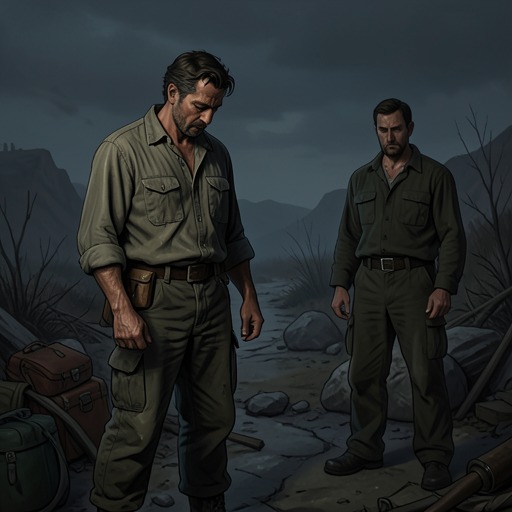
The Narrow Road to the Deep NorthRooster MacNeice survives the war, but survival does not resolve the consequences of his choices. In the prisoner-of-war camp, he tries to master himself through daily memorisation and treats hatred as a sustaining force; at the same time, hunger, envy, and humiliation repeatedly overwhelm that discipline. His failure to stand beside Darky Gardiner when the Japanese demand that the guilty step forward becomes the central moral wound in his wartime story, and the later discovery of a duck egg in his own kitbag sharpens rather than eases his remorse.
Identity and Discipline
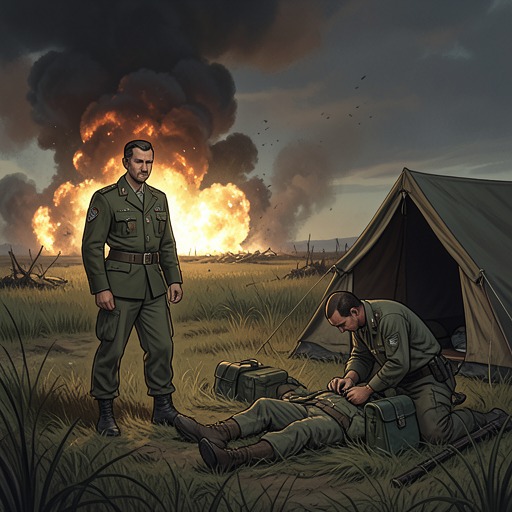
Rooster is introduced in wartime as a soldier whose reputation for ineptitude makes others surprised when he can hit a target. During an enemy strafing attack, a pilot escapes by parachute. Rooster takes a rifle and aims at the descending airman, despite Dorrigo Evans pushing the barrel away and warning him against firing. Rooster answers with the deaths of Yabby Burrows and a young boy as justification. He fires anyway and hits the parachutist. Later, when the men eat the cold porridge from the hot box Yabby had been carrying, no one sits with Rooster. The scene connects his grief and anger to an act that isolates him from the group rather than restoring what has been lost.
In the camp, Rooster gives himself a strict morning routine. After waking to Jimmy Bigelow’s bugle, he recites a page of Mein Kampf that he has memorised, aiming to learn a page each day and keep his intellect from stagnating. The ritual is also an ideological exercise: the book’s antisemitic passages are easiest for him to retain, while he struggles with its account of the early Nazi Party. His self-image as a man maintaining discipline sits uneasily beside the material he has chosen to discipline himself with.
Hatred is not incidental to Rooster’s character but, in the narration, a force he uses like nourishment. He despises people across racial and national groups, including the British and Americans, and finds so little to admire among Australians that he sometimes argues they deserve conquest. His contempt reaches Darky Gardiner, whom he regards as dirty and untrustworthy, and extends to Gardiner’s singing of Without a Song after the men return from the Line. Rooster resents that other prisoners enjoy the song. His stated effort to preserve his intellect therefore coexists with a worldview that reduces people to hostile categories and makes companionship difficult.
Hunger, Envy, and the Duck Egg
The camp’s deprivation exposes the gap between Rooster’s ideals and his bodily needs. When he receives rice water in the monsoon rain, he understands that it is not really food but survival. He admires the way Darky makes a small ceremony of eating, drawing out a meagre ration with patience, but Rooster cannot imitate him. He eats his own portion too quickly, then looks up to find Darky still eating. Rooster imagines that one day he will eat slowly enough to make the other starving prisoners watch him with envy, but his hunger defeats the resolve each time. The dignity he envies in Darky is inseparable from a scarcity that Rooster cannot master.
The duck egg becomes the object around which this rivalry and humiliation gather. After an embarrassing episode involving an eggshell and Tiny Middleton, Rooster searches his kitbag for Mein Kampf and finds that the egg he had bought and hidden there three days earlier is missing. He decides that Darky stole it and used the theft to mock him. Rooster imagines that the others would laugh if he accused Darky, and his anger at him becomes more intense than his ill feeling toward the Japanese. The episode reveals how completely a private slight can govern Rooster’s moral attention: a stolen ration matters more to him, in that moment, than the larger violence of captivity.
Darky and Tiny’s companionship further exposes what Rooster lacks. In the rain, he watches Tiny crawl toward the parade ground while Darky walks alongside him, offering support twice but not forcing it on him. Rooster recognises a loyalty between men who might mock him but would not abandon each other. The sight fills him with hatred because he cannot make sense of a kind of solidarity that appears to him to be theirs and not his. He turns back to the bamboo and tries to imagine it as the arches of a cathedral, attempting to fill his heart with beauty instead.
Darky’s Death and Rooster’s Guilt
Rooster’s relation to Darky changes most decisively when the Japanese demand that the guilty prisoners step forward. The next morning, Rooster cannot begin his usual memorisation. During the previous day’s demand, he had not been thinking chiefly about the Japanese shouting at the men; he had been thinking about Darky’s laughter during the duck-egg humiliation. Rooster stays silent rather than acknowledge that hiding from work had been his idea. Darky is later dead, and Rooster understands that his silence helped leave him to face the consequences alone.
In the night, Rooster turns over possibilities he cannot settle. If he had stepped forward, he thinks, Darky might not have died; Rooster might instead have died, or both men might have. He tells himself that the Japanese were unpredictable and that Darky may have been doomed anyway, as a sick man and the sergeant in charge of the gang. These explanations do not erase the fact that the earlier humiliation had shaped his decision. Rooster had not intended Darky’s death, but his remorse centres on the choice he did make: he would not help a man he believed had stolen from and mocked him.
When he reaches into his kitbag for his memorisation book, Rooster finds the duck egg tucked inside a dress uniform shirt he has kept neatly folded through his hardships. Relief at finding the egg gives way almost immediately to shame. He puts it back as if it were something that must be hidden and takes out Mein Kampf, but he can no longer memorise its words. The return of the egg overturns his certainty about the theft without explaining how it came to be there. Its presence makes his grievance look smaller, while his failure to act for Darky remains irreversible.
Survival and the Postwar Story
Rooster survives the camp and appears in the veterans’ postwar recollections as a man who talks about being bayoneted by the Japanese. At the Broadmeadows RSL, Gallipoli von Kessler challenges the account. Rooster dismisses the challenge as characteristic of Gallipoli and says the guard was known as the Mountain Lion, adding that he testified about him after the war. The episode presents a public version of Rooster’s wartime experience that is contested even among former comrades. His story of the guard is not the same as his private memory of the silence that preceded Darky’s death.
At the Hope and Anchor, Sheephead Morton remembers Rooster among the dead and missing men whose lives the veterans revive in conversation, even describing him as a wretched man who should have been dead. The gathering’s remembrance does not make Rooster’s actions heroic or settle their consequences. Set beside the camp scenes, it underscores the distance between the group’s capacity to carry its dead together and Rooster’s solitary habit of converting experience into grievance, rehearsal, or a story he can tell. His survival is real; so is the unresolved knowledge that, at a decisive moment, he chose not to stand with Darky.